
Telling Tales
In one of TheEye‘s “what should I do” moments, too early for a Netflix binge and her limited powers of concentration plummeting to Ground Zero, she started reading through some drafts of a work in progress about her time working for Charles Saatchi and his first wife, Doris.

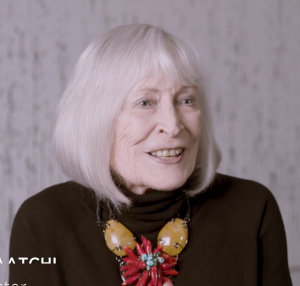
Credit: Charles Saatchi 2019 REX Shutterstock, Doris Lockhart 2019 CURATED
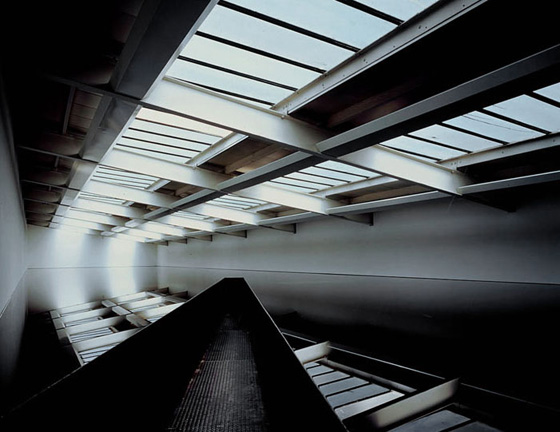
In 1985 she read an intriguing article by The Guardian’s art critic Waldemar Januszcek, “Saatchi opens his Aladdin’s Cave”, reporting the couple had converted a paint warehouse in St John’s Wood into a gallery designed by architect Max Gordon. Four times larger than the Whitechapel and ten times bigger than the Serpentine, with the most impressive collection of contemporary art in Great Britain (not that that was saying much at the time) – more Warhols, Kefers and minimalist painters than had ever been exhibited in the UK. With no introduction, she wrote a letter expressing interest in working for them. One of those rare perfectly timed moments. The Saatchis hired a curator, Julia Ernst, a young smart American woman from the Angela Westwater Gallery in New York and brought her to London.
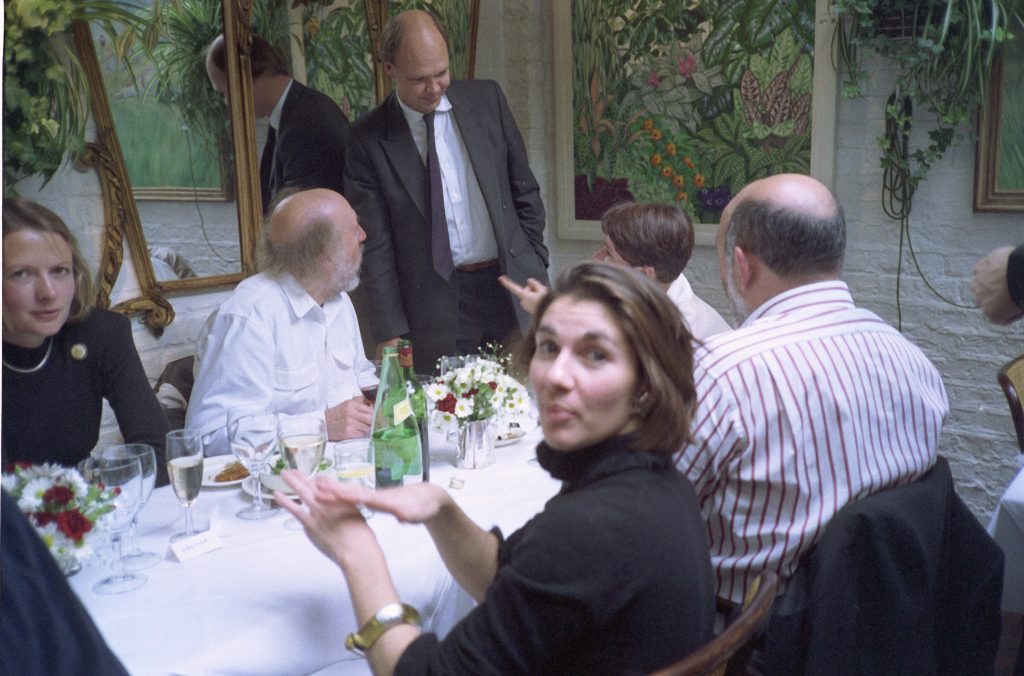
Julia Ernst
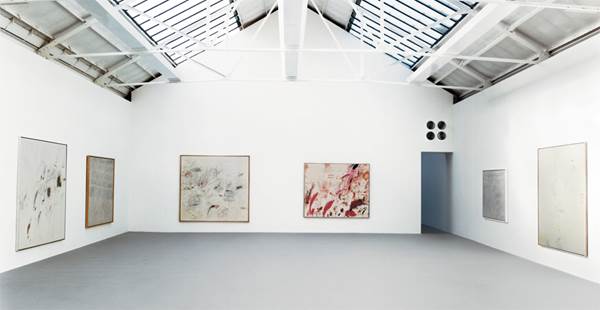
Julia was snowed under with work. They had just published the four volumes of their art collection, Art Of Our Time, to coincide with the opening of the gallery. Interest in seeing the mysterious gallery was intense. I was interviewed by Julia, hired straight away – which involved a large degree of bluff on my part regarding my knowledge of contemporary art – the minimalists, for example, who exactly was Brice Marden or Agnes Martin? Blank canvases were all I could see, maybe they were paint samples on the grey wall? The inside of the gallery was grey. Grey walls, grey floors. Today that is a contemporary gallery cliche, but back then it was an avant-garde statement. However, Julia was obviously convinced, clearly desperate for an extra pair of hands – and I was plunged in at the deep end and started work immediately remaining until 1992. Assistant curator, P.R., bottle washer, tea maker – anything that needed doing was done between Julia and me – not like the snooty gallery receptionists that barely make eye contact and smile (god forbid) working today.
Copyright 2009 Kenny Schachter
Copyright 2018 Saatchi Gallery
I have selected a few much-shortened extracts for the next few posts on some of the more interesting/ hilarious/crazy things that occurred – and there were so many. Back in the ’70s and ’80’s, the art world was a very different place. Over the years I met and worked with many famous artists as well as many who didn’t make the grade. Charles was no altruistic saint and his low boredom threshold was epic. A young artist’s work, usually spotted at a college graduation show, could be acquired cheaply and in-depth (a Saatchi formula) and then just dumped. A disaster for young artists, shattering their confidence. A case in point, he once returned from an art-buying spree in New York, with six truly grisly pictures of dead carcasses hanging in an abattoir and ruefully admitted he had no idea why he bought them and they were instantly disposed of. He showed them to us asking, “what on earth made me buy these?”, to which we replied, “You tell us.”
So where to begin – the first show in March 1985 included 15 Warhols, Donald Judd, Brice Marden, Agnes Martin. British art enthusiasts simply weren’t prepared, but they were certainly curious.
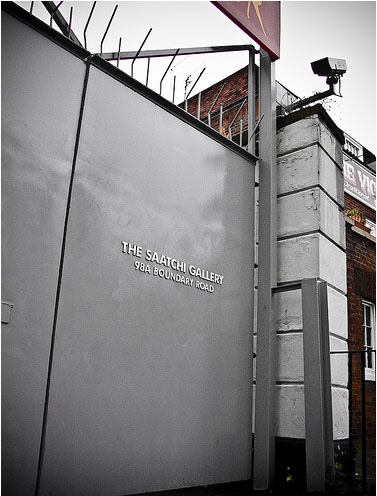
First of all, finding the gallery (referred rather pretentiously as The Collection) was a challenge – an anonymous grey gate with spikes on top opposite the Dee West dry cleaner, with the Bonny Sue second-hand clothes shop and Jack’s cafe squeezed next door. It resembled the entrance to a young offender’s hostel. Boundary Road NW6 was drab. Only just qualifying as St John’s Wood before it morphs into West Hampstead. There was an intercom with a camera perched above it but no name. You identified yourself and were instructed to press a buzzer and then admitted. We opened to the public at weekends or to those more “important” it was by appointment – exclusivity being important to some.
Copyright 2009 Kenny Schachter
After their divorce, Charles became the “face” of the Saatchi Collection, as if Doris had never existed, which was far from the truth. With her art history Ivy League University background, she had been the driving force. Charles relished the role of a recluse and refused to be interviewed, never attending his own opening parties. A wonderful way to get people enthralled. Well, he was an adman and knew all the tricks of his trade.
The definition “collector” is today much misused. Any old Joe or more accurately young Hedgy can qualify. What’s the point of having money if no one can see it and high profile art on your walls says everything short of framing banknotes — and much more fun! I am now adept at recognising a genuine collector when I meet one. Totally driven, they will go to any lengths to get what they have set their heart on. No obstacle is too big to stand in the way of them and their prize. I remember being at some art dinner when a man I had met at the Gallery came and said hello with his dinner companion. “Who is that”I heard her ask him, “Oh, they are just collectors” was the reply, and I knew from that moment that one thing I wasn’t was just a collector. We bought pictures or objects we fell in love with and could afford, very different. I was once rebuked by an artworld grandee for calling art buyers shoppers. He said I was being “snobby” but there is another term coined by the legendary art dealer, Irving Blum, – “tepid collectors”. Who cares, you might ask? But my favourite collector story of many concerns Marcia Weisman, “the high priestess of the L.A. art world” in the ’60s and ’70s and best buddies with artist such as Jasper Johns, Barnett Newman, Ellsworth Kelly, Claes Oldenburg and, of course, David Hockney. She and her first husband, Fred, were the subject of the iconic double portrait “American Collectors” painted in 1968 by David Hockney. It’s a brilliant study of the pair in their perfect garden in their perfect contemporary Los Angeles home, Marcia wearing her perfect hostess gown. The painting symbolized the idea of the good life in the Sixties in Southern California and the life that seduced Hockney himself. The blue of the sky and the swimming pools – all so alluring to a young, gay artist from Bradford.
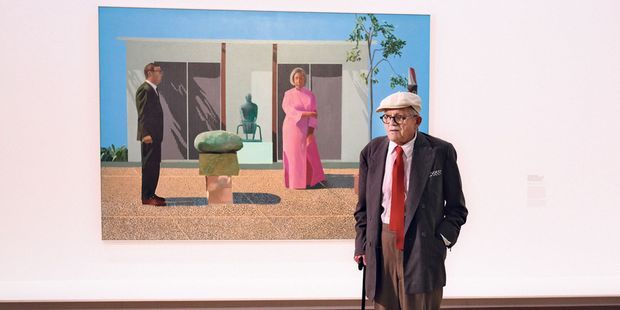
David Hockney in front of his painting “American Collectors”. Copyright 2019 Centre Pompidou
Marcia died following a stroke in 1991 and even by L.A. standards the funeral she had choreographed for herself was wonderfully and grotesquely bizarre. To the surprise of those attending what they assumed was a Memorial Service, they found Marcia decked out in one of her signature gowns lying in an open casket covered with white lilies in front of a massive Richard Serra sculpture. You have to applaud her. She was, without a doubt, a single-minded Big C collector, both in her lifetime and, maybe, beyond the pearly gates.
Ethel and Bob Scull were another colourful art collecting couple having converted their fortune made from Yellow Taxi Cabs to art, thriving on the attention art conferred on them. The Sculls were unworried by claims that they used art to scale the heights of New York society. Bob once remarked, “I’d rather use art to climb than anything else”. The Sculls’ marriage didn’t end well and after their divorce in 1975, a 10-year wrangle ensued, with Ethel (who went by the name Spike) claiming she had “not enough for a sea-urchin to live on”. They ended up splitting the collection by flipping a coin.
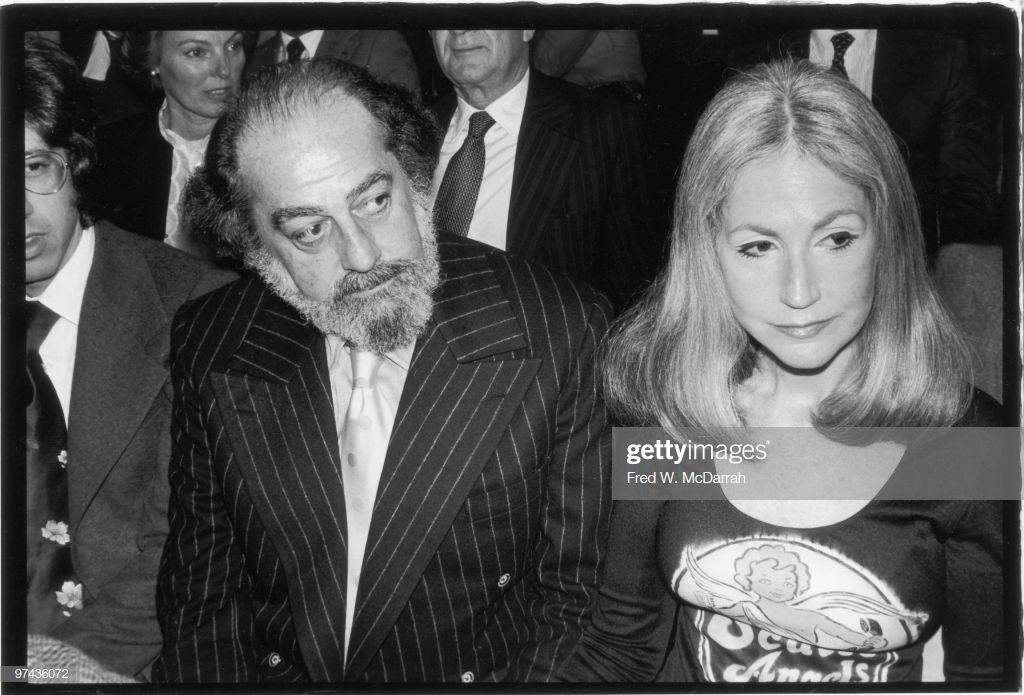
Ethel and Robert Scull
The frenzied buying of today is not new. From my stack of reference art magazines going back to the 1970s, it was always thus. As Leslie Singer, an economist and art historian commented, “every collector will tell you that he buys art because he likes it, but that’s baloney.” And Andy Warhol summed it up, shrewdly observing, “business is the step that comes after art and good business is the best art.”
Sitting next to a New Jersey shopping mall billionaire, (who wasted no time in making sure I was very aware of this fact ), I asked if he collected art as we had very little else in common to discuss. “Oh yes,” he replied, “we have three houses and they are all stuffed with art”. When I asked about the artists in his collection, he answered, as quick as a flash: “Oh, all the names.” The gentleman went on to be the chairman of one of New York’s premier art museums, where I hope he remembered some of the names. As Larry (GoGo) Gagosian remarked, “I don’t hang around with collectors with no money. Sometimes collectors with money can be a great asset.” Profound words.
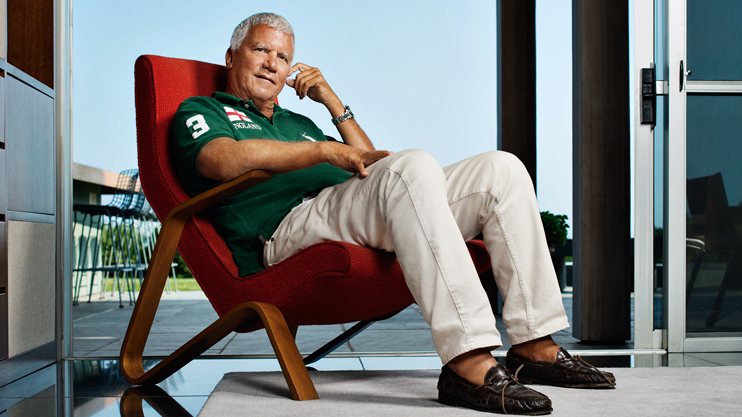
Larry Gagosian. Copyright 2019 Public TV Company of Armenia
Without a doubt, the Saatchis were put on a pinnacle as the high priest and priestess of Collectors. In the ’70s and ’80s, dealers liked selling to them because they didn’t, as the über New York dealer Leo Castelli said at the time, “cherry-pick” and would buy several works as a package deal for an attractive price on the understanding that the works would be kept together and not sold on the open market. Of course, this wasn’t honoured and there were many accusations of reneging on agreements, but you get different versions of the story depending on who you talk to. Like Chinese Whispers, it’s hard to know who really knows the truth and the art world is like a hairdresser’s, full of delicious gossip. The Australian critic, Robert Hughes never shied from targeting a venomous arrow at what he regarded as the evils and skullduggery of the contemporary art market. Collectors were always at the end of his sharp stick. Writing in the ’80s, he predicted, “it’s no distinction to collect. Soon it will be merely vulgar” – and the quotes come thick and fast from others. Donald Kuspit, another powerful American critic, also had a few hard-hitting works on the subject.”Art these days is the ultimate symbol of social prestige, the ultimate property by which success measures itself, the ultimate satisfaction, after the material success and the social prestige it brings with it, can only go so far in giving one a sense of personal worth. What easier way to be spiritual – to overcome that jaded feeling to own, even hoard art.”
And there are many hoarders.
I met speculators, who boasted on garages or warehouses full of art purchased speculatively as just another investment. “In these days [1999] art is a surer investment than gold. Art has the potential to turn a better profit than soya beans and of course, it’s more beautiful. What’s more, soya beans won’t buy you the social entree, but having a nice collection of art might.”
Dealers would phone to ask if they could bring a client to Boundary Road and the client was always “someone very important” from the US or Europe. They would flip through the catalogues identifying artists they owned themselves or felt they should own. Occasionally, an artist would come, too. I remember Anselm Kiefer paying a visit with Nick Serota, who was still the Director of the Whitechapel Gallery and was surprised to see the cool Serota behaving like a star-struck fan walking Kiefer around deferentially.
Julia and I frequently entertained friends to tea and some artists came quite regularly – Francis Bacon, for example, accompanied by his “walker” Derek Juelle – an Andy Warhol look-alike with a broom-like thatch of dyed blonde hair. They always phoned before coming to check if it was convenient. Francis Bacon was very funny and talkative with Julia and me. He loved a good gossip and in our teatime chats, he was very relaxed until we walked around the galleries looking at pictures and people would notice him and ask us in stage whispers, “is that Francis Bacon?”, upon which they would practically bow at his feet and he wasn’t pleased. On the other hand, he loved talking to students, particularly young men and asked them endless questions about themselves, their art preferences and ambitions.
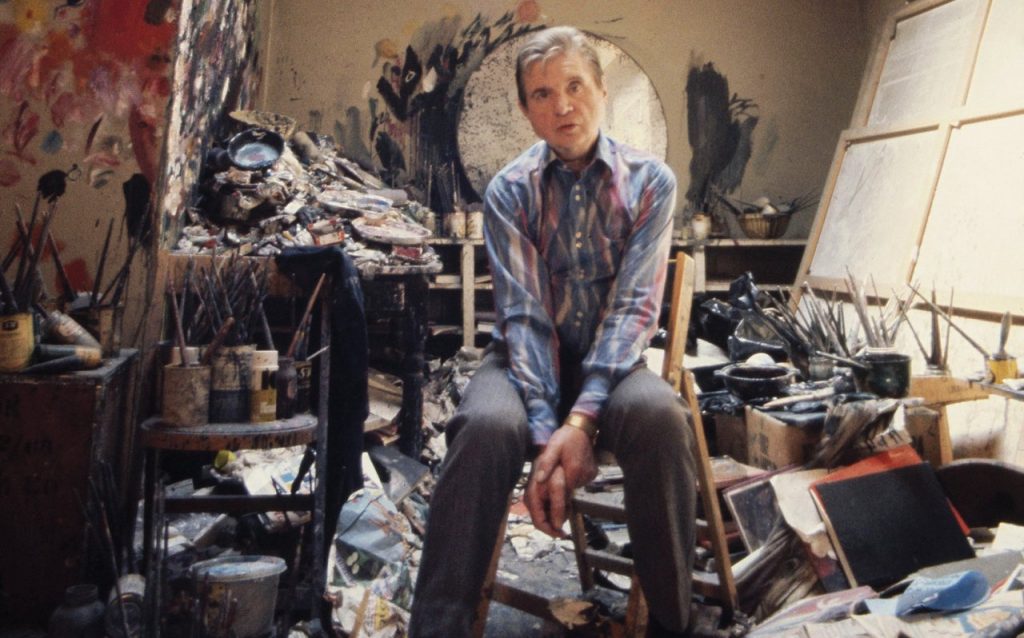
Copyright MICHAEL HOLTZ / PHOTO 12 / ALAMY
One afternoon, a friend of Julia’s, who had also become a friend of mine and my family’s, a very handsome and suave Spaniard, José Capelo, working in London for management consultancy Bain & Company, came to visit us and coincided with Francis who was attracted to him at first sight. He invited us to dine with him at The Connaught Grill, although we knew who he really wanted to be with and it wasn’t Julia or myself. Jose became Francis Bacon’s last lover and after his death inherited five paintings. He went to live in Spain and we sadly lost touch.
TheEye hopes you have enjoyed her introduction to the way things were “back when” – in a different world.
For the next few weeks, there will be more art world tales TheEye will be sharing with you.
Enjoy and do please keep following!
Jan,fascinating stories! Great that you are sharing them for us all to enjoy.
Can’t wait for the next chapter.
Linda Science
A brilliant first chapter to what just has to be a book or weekly column. The quotes and the stories we would never have known about conjure up the magic of a unique era in the art world. Loved hearing about teatime with Francis Bacon and the romantic dinner at The Connaught Grill. Can’t wait for more.
Brilliantly written and observed. Looking forward to reading more.
Boundary Road was so obscure in those days Jan but I can definitely remember the magnificent space, knowing Max Gordon who was so elegant and the smell of the oil. It definitely awakened all the senses. I think it was even Waldy who was my best mate at uni in manchester who took me there originally and I was hooked. My little gallery had just closed- bad timing! Great memories…. thanks.
Boundary Road was so obscure in those days Jan but I can definitely remember the magnificent space, knowing Max Gordon who was so elegant and the smell of the oil. It definitely awakened all the senses. I think it was even Waldy who was my best mate at uni in manchester who took me there originally and I was hooked. My little gallery had just closed- bad timing! Great memories…. thanks.
A brilliant flashback to Boundary Road. Thank you for sharing! I was just a student then, but still the memory of the space and smell of the Richard Wilson installation is very evocative!
What great stories from what now seems like another time and I can’t wait for more every week… I remember working behind the desk on Saturdays and every week, like clockwork, someone managed to ruin their clothes in Richard Wilson’s oil pool. It was lucky there was a dry cleaner over the road…!
And every week they expected us to pay the dry cleaning bill for their stupidity.
Loved reading this Janice / loved seeing all the images as well ! I only came into the art world in 1999/2000 after studying at Christie’s Education and doing Roger Bevan’s subscription series / I learned so much so quickly and met great people and saw great Art ! Loved that first Saatchi Gallery space! Richard Wilson’s oil pool absolutely the best ! More more ! Film will come as I believe you ( like me ) have talent in your family !
Oh I loved this Jan. Thank you. Saatchi bought some of my niece’s work. He beat her down and down on price and then again when a runner came to collect the work. A right ……. use your own word!
Keep on I want more!
how can we ever forget, such a wonderful era. Just walking into the ‘oil swimming pool’ … Was always so honoured to receive the invitations ..
Fascinating stories, can’t wait for the next chapters!
Such a clear and interesting recollection..
Thank you for sharing it and marking it for the recordxx
Jan. so many memories of times gone.
A fascinating and breathless journey through the early days of Boundary Road…. as good as any article one might have read in Vanity Fair… and all lies before you… Richard Wilson’s oil… Damien Hirst’s flies and shark… thank you for reminding us of those great days of promise in an awakening London… but who will be the cast when the film rights are auctioned?
Roger coming from you who has been there, seen it and done it – this is a huge compliment and encouragement. The best is yet to come which of course includes Richard’s oil (hilarious) and Damien’s shark (even more hilarious), Sister Wendy and more. These are just small extracts. Film rights…ho ho. But do enjoy next week’s chapter on parties and an evening with Richard Serra.
Love all the quotes especially the Andy Warhol one – so on the money. Sadly modern collectors are nothing like previous generations who although also very rich themselves, hunted down unknowns, befriended the artists & cherished their purchases. Your descriptions of Boundary Road brings back such great memories, such a cool venue. Wish I’d known you then.
Great reading…. longing to know if you were a proper collector before working at the gallery and how you became one.
A true cliche ‘I remember it well’ said Maurice Chavalier. Saying that how it does reawaken ones senses to the art world of yesteryear in both England and America.
The Saachis were the beginning of The English Scene , and brave, with their launch and continuity . They truly set the trend .
America was way ahead at that time.
Looking forward to reading the next and the next , as I was writing on Art as an investment for Money Mail at that time.
What I could have bought ………
Jan, that is so exciting to read, it has to be a book !
love this episode of The Eye. memories of Boundary Rd, Julia et al. please turn this into a book!
Jan, i love reading about your experiences. What an interesting life.
Keep well.,
Fortuna